





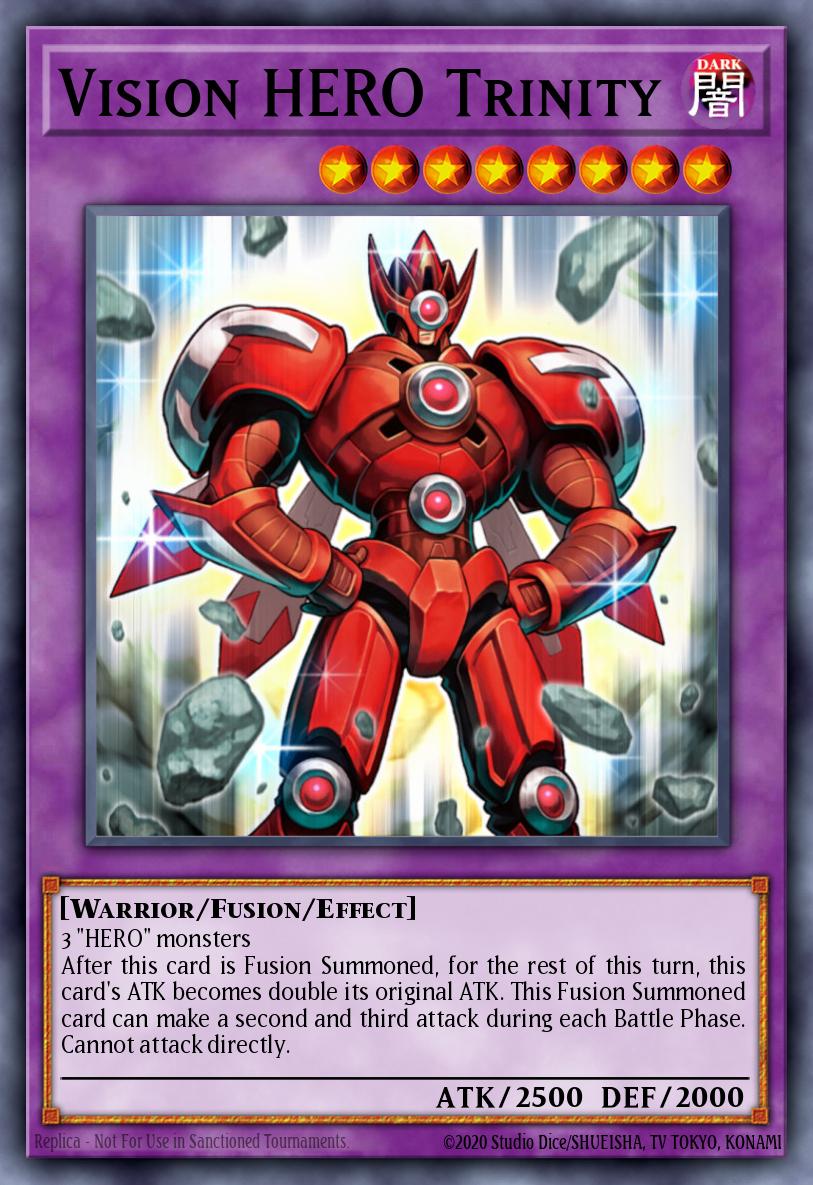

 DARK
 8
Vision HERO Trinity
Archetype:
Vision HERO
ATK:
2500
DEF:
2000
View:
8204
3 "HERO" monsters After this card is Fusion Summoned, for the rest of this turn, this card's ATK becomes double its original ATK. This Fusion Summoned card can make a second and third attack during each Battle Phase. Cannot attack directly.
Vision HERO Trinity — Power Evaluation
Final Score: 56 ± 6 · Confidence: Medium
- Intrinsic: 50.7 · Deck: 59.1 · Meta: provisional
- Primary role: Boss/End-board
Why it scores here
Vision HERO Trinity is a Fusion attacker that needs three HERO monsters, and it is live in almost every deck in the sample (400/400, with Polymerization on 97%). Its 2500 ATK doubling and two extra Battle Phase attacks convert a Fusion Summon into a boss-level board, as the three recorded combos show (power index 100, 3-4 end monsters). The high 2500 base ATK and the 100% combo appearance earn only modest credit, because the card has no interaction, no card advantage of its own, and no protection against a single removal or negation. Its score is held down by the Fusion-only route and by the fact that its deck presence is mostly the HERO package's core rather than evidence the card is intrinsically strong.
Axis scores
| Axis | Score | Evidence |
|---|---|---|
| Accessibility | 70 | Needs three HERO monsters plus a Fusion Summon, and Polymerization is a partner in 97% of decks, so it is reliably live in the sample (deck data, observed). |
| Combo & Conversion | 80 | All three recorded combos reach a power index of 100 with 3-4 end monsters and 1-3 boss monsters, but the card's own role tags are all zero (combo data, observed). |
| Resource Economy | 55 | No draw, search, or recursion of its own; board-level net card advantage of 4-5 comes from the wider combo, not this card (combo data, observed). |
| Effect & Interaction | 10 | No negation, removal, or hand-trap text; its effect is purely offensive (card text, verified). |
| Material Utility | 20 | Level 8 Fusion monster with no recorded use as material in any combo (material role count 0) (combo data, observed). |
| Resilience & Flexibility | 40 | Multi-attack threat that does not survive a single removal or negation before the attack, and the sample pairs it with Ash Blossom & Joyous Spring to cover that gap (card text and deck data, inferred). |
| Deck-Building Efficiency | 70 | One copy per deck in a single Extra Deck slot with no garnet or lock text in the evidence (deck data and card text, verified). |
Calculation
Weight profile: Boss/End-board primary only; no secondary blend. Intrinsic ≈ 50.7, Deck ≈ 59.1, Meta = provisional. Modifiers: none. Final formula: 0.40*Intrinsic + 0.60*Deck
Strengths
- Reliably accessible in HERO decks through Polymerization (97% of decks)
- Doubles 2500 ATK and gains two extra attacks, so one Fusion Summon can end the game
- Appears in all three recorded combos with a power index of 100
- One copy per deck with no garnet or lock cost
Weaknesses
- No interaction, draw, search, or recursion of its own
- Requires three specific HERO monsters and a Fusion Summon
- A single removal or negation before the attack ends the threat
- Cannot attack directly
Counters / choke points
- Ash Blossom & Joyous Spring (recorded as a frequent partner, which suggests it is run as protection rather than as a counter)
Best use
Boss/End-board attacker in HERO Fusion builds. Decks: Heroic, Destiny Heros, Heros, Vision HERO. Suggested copies: 1.
Evidence & gaps
- Verified: Requires three HERO monsters; after Fusion Summon, ATK doubles for the turn and it can attack twice more in each Battle Phase; it cannot attack directly (card text); Level 8 DARK Warrior Fusion Monster with ATK 2500 and DEF 2000 (card data); Runs one copy in 400 of 400 sampled decks (deck data)
- Observed: Polymerization appears in 97% of sampled decks (deck data); All three recorded combos show power index 100, averaging 0.33 starters (combo data); Included in Heroic at 100% typical copies in usage statistics (usage statistics)
- Inferred: Ash Blossom & Joyous Spring is run to protect the Fusion line rather than to counter it (deck data co-occurrence, inferred)
- Data gaps: no banlist token — assumed 3 copies (unlimited) only 3 recorded combos, so the combo evidence is thin no card-specific ruling or interaction data the 22 distinct archetypes include duplicate HERO names, so the archetype spread is overstated